How precious are Your thoughts to me, O LORD ... how vast is the sum of them!

Tuesday, July 30, 2013

The Slough of Delight

I returned home from a thirteen-day holiday early on Saturday morning. During the second week, when I was in South Dakota, I wrote a bit everyday, whether it was emails or journaling or brainstorming on the Regency novel that my friend Laura and I are writing. It wasn’t nearly as much writing as I normally do. But it was a perfect break, because all the out-of-the-ordinary things I experienced filled my inspiration up to the brim and I’ve been yearning to get back to my writing life.

There’s several things I could write blog posts about -- where to start? Perhaps the most exciting, interesting subject to a literary blog … my visit to the world of Laura Ingalls Wilder’s books By the Shores of Silver Lake, The Long Winter, Little Town on the Prairie, These Happy, Golden Years, and The First Four Years. I thought I was a fan before, but after I visited De Smet, South Dakota, where the Ingalls family lived from 1879 on, I’m aflame for the Little House books and Laura Ingalls Wilder’s life.

There’s nothing like seeing the real setting of history or stories you love. I don’t recall what I pictured when my mom and I read the Little House series years ago, but it wasn’t quite what I saw last week. I anticipate reading the books again with my new perspective!

I saw the Big Slough where Laura and Carrie got lost in the beginning of The Long Winter. That was my first glimpse of Laura’s land, and it delighted me to no end. Look how tall the grass is! It swallowed them easily. No wonder Ma was always afraid little Grace would wander into it.
                                         
                                                Did you know “slough" is pronounced “sloo"?
“So they did not follow the road that turned to cross the slough. They went straight on into the tall slough grass.

“At first it was fun. It was rather like going into the jungle-picture in Pa’s big green book. Laura pushed ahead between the thick clumps of grass-stems that gave way rustling and closed again behind Carrie. The millions of coarse grass-stems and their slender long leaves were greeny-gold and golden-green in their own shade. The earth was crackled with dryness underfoot, but a faint smell of damp lay under the hot smell of the grass. Just above Laura’s head the grass-tops swished in the wind, but down at their roots was a stillness, broken only where Laura and Carrie went wading through it.” (The Long Winter)

Silver Lake itself has been drained, but all over that area of South Dakota are little round, glassy lakes that must have been very similar.

“The lake lay at their left shimmering in the sunshine. Little silvery waves rose and fell and lapped upon the shore as the wind ruffled the blue water. The shore was low, but firm and dry, with little grasses growing to the water’s edge. Across the glittering lake, Laura could see the east bank and the south bank, rising up as tall as she was. A little slough came into the lake from the northeast, and Big Slough went on toward the southwest in a long curve of tall wild grasses.” (By the Shores of Silver Lake) 


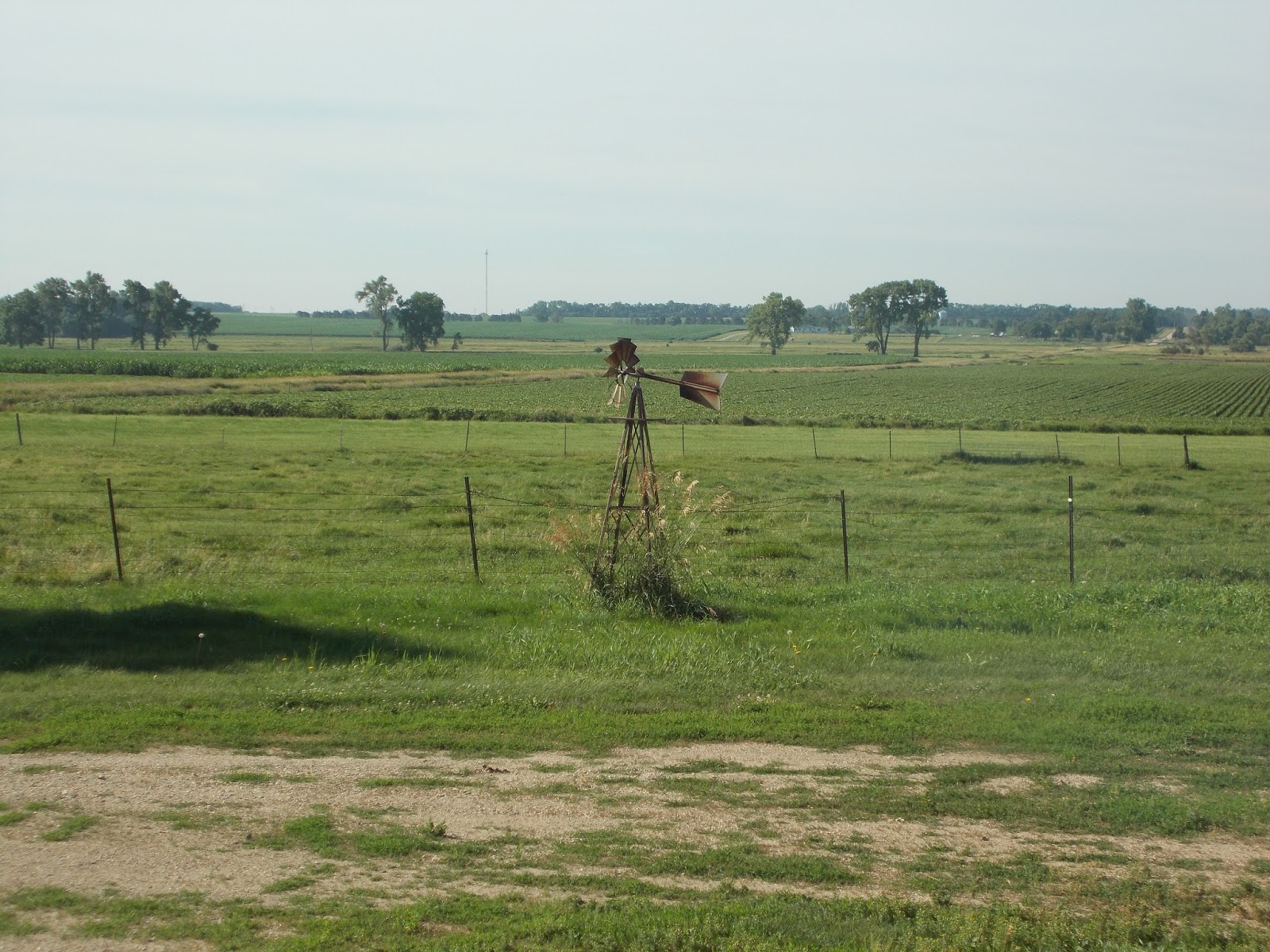
Eastern South Dakota is similar to Minnesota, which is called the Land of Ten Thousand Lakes. Being from Texas, the small, full bodies of water dotting the prairie was a novelty. Now I know why Laura mentioned so many lakes in her books and why she wrote so often of Silver Lake and the Big Slough. It’s beautiful! Here are some more images of the South Dakota prairie:




On a side note, don’t you just love the simple, warm, yet descriptive way in which Laura Ingalls Wilder writes? Writers describing their homeland are often at their best!

Stay tuned for Part 2 of my Little Town on the Prairie adventures.


Friday, July 12, 2013

Classics in the Bag, Part 2

                                Spend all day in a library like this. Reading every book that I can<3                                                                           pinterest
I will soon be leaving for two weeks to go to a summer camp and visit a good friend, so this will be my last post for the time being! I’m not promising, but I may be able to post the second week I’m gone -- however, that will greatly depend on inclination. Let’s face it, I may be too busy having fun!

With that said, here’s part two of my chronological list of pre-1900 classics! I welcome comments and discussion on anything listed here.


  • Victor Hugo (Feb 26, 1802 - May 22, 1885) - The Hunchback of Notre Dame, 1831
What a book. I liked it yet didn't like it. The pathos was incredible, which depressed me but made me acknowledge Hugo's power. I'm glad I read it, but I would definitely not read it again.
  • Alexandre Dumas (Jul 24, 1802 - Dec 5, 1870) - The Count of Monte Cristo, 1844
I think this was one of the best novels ever written -- the scope is amazing and the story is powerful. Without knowing it, I read one of many abridged versions, so one day I'll have to read the whole thing!
  • Nathaniel Hawthorne (Jul 4, 1804 - May 19, 1864) - The Scarlet Letter, 1850
I love Hawthorne's rich style. The plot is disturbing, but the analysis of human nature is intriguing.
  • Elizabeth Gaskell (Sep 29, 1810 - Nov 12, 1865) - The Moorland Cottage, 1850
If I remember correctly, this was Gaskell's first story. It is so sweet and, though simple, demonstrates Gaskell's amazing character development.
  • North and South, 1855
Gaskell is perhaps my favorite novelist, and this compelling book showcases the depth of her talent.  It's about two ways of life, but its genius lies in how neither one is extolled or degraded above the other.
  • Wives and Daughters, 1865
Another amazing novel, again with a cast of extensively-developed characters. Sweet and relatable Molly Gibson is my favorite!
  • Charles Dickens (Feb 7, 1812 - Jun 9, 1870) - A Tale of Two Cities, 1859
I find it hard to believe that I've only read one Dickens novel so far, but I think this was an excellent place to start and a qualified display of his mastery.
  • Anthony Trollope (Apr 24, 1815 - Dec 6, 1882) - Phineas Finn, 1867-68
I liked it, but it didn't leave me particularly eager to read the rest of the series; Trollope has a handle on interesting characters, but I think I may like The Barchester Towers better. (Thanks for the recommendation, Sarah and Hannah!)
  • Charlotte Bronte (Apr 21, 1816 - Mar 31, 1855) - Jane Eyre, 1847
Along with North and South and Wives and Daughters, here's one of my favorite books!
  • Emily Bronte (July 30, 1818 - Dec 19, 1848) - Wuthering Heights, 1847
Very interesting. Being from a very rational family, I found the unbalanced minds of the characters hard to understand. But, I must say, the writing was stellar.
  • Elizabeth Prentiss (Oct 26, 1818 - Aug 13, 1878) - Stepping Heavenward, 1869
This was an amazing and touching book on giving oneself to God and to others.
  • Herman Melville (Aug 1, 1819 - Sep 28, 1891) - Moby-Dick, 1851
I liked parts of it, but they were few and far-between. Melville is a skilled word-crafter, but he could have groomed his plot a little.
  • George Eliot (Nov 22 1819 - Dec 22, 1880) - Silas Marner, 1861
My introduction to Eliot's genius; its interconnectedness was a beautiful thing to see, and its philosophical probing was fascinating. Silas and Eppie -- such a sweet pair!
  • Daniel Deronda, 1876
This was a step-up from Silas Marner; it possessed the same attributes, but on a wider scale. I loved the Jewish characters and theme that enter the story. Eliot was one of the first major authors to portray Jews sympathetically. It was a huge step.
  • George MacDonald (Dec 10, 1824 - Sep 18, 1905) - The Princess and the Goblin, 1872
My mom read this to us when we were young, and we made a study notebook on it, complete with drawings! The story was neat, but I don't remember much of the writing.
  • Jules Verne (Feb 8, 1828 - Mar 24, 1905) - Twenty Thousand Leagues Under the Sea, 1870
Captain Nemo was interesting, as was the novel's concept; but some parts I found dry.
  • Around the World in Eighty Days, 1873
I liked this much better than the other; world travel fascinates me to no end, and I read the end on pins and needles!


Tuesday, July 9, 2013

Classics in the Bag

I think most of us book-lovers also love lists of books -- these lists can bring back memories, open up possibilities, and spark conversations. Since I was short on blogging time today, I thought I’d simply share part of my list of classics that I’ve read, and by classics I mean novels written before 1900. There are both wider and narrower definitions of classic literature, but I’m sticking with that rather unsophisticated definition for simplicity’s sake! I’ve heard of “modern classics,” and those are basically written after 1900, and I'll probably share those eventually, too.
One of my personal goals is to read as many classics like this as I can, so that’s partially why I made this list in the first place. Today I'm only sharing the novelists I've read who were born before 1800:

  • John Bunyan (Nov 28, 1628 - Aug 31, 1688)  The Pilgrim’s Progress, 1678
      Amazed by the extent of the allegory and its lessons, I think everyone should read it! 
  •  Daniel Defoe (c. 1659-1661 - Apr 24, 1731) - Robinson Crusoe, 1719 
      A mite boring at times, but overall interesting. Crusoe's faith in God was inspiring, if I remember right.
  • Jonathan Swift (Nov 30, 1667 - Oct 19, 1745) - Gulliver’s Travels, 1726
      Fascinating but weird at times. Swift had one of the largest imaginations ever!
  • Oliver Goldsmith (Nov 10, 1730 - Apr 4, 1774) - The Vicar of Wakefield, 1766  
      Disturbing in some ways, this was a little book that somehow felt incomplete. But the vicar was interesting.
  • Fanny Burney (Jun 13, 1752 - Jan 6, 1840) - Evelina, 1778
      Written entirely in letters, this was sometimes melodramatic but good overall!
  • Fanny Burney - Cecilia, 1782
      This was a huge, enveloping book, but Cecilia was truly someone to be admired.
  • Fanny Burney - The Wanderer, 1814
      This was another huge book, this time with a sustained mystery throughout. It was a wonderful ride!
  • Jane Austen (Dec 16, 1776 - Jul 18, 1817) - Sense and Sensibility, 1811
      I've read this three times. Elinor is my favorite literary character. Need I say more? 
  • Jane Austen - Pride and Prejudice, 1813
      It's no wonder that this book is popular! Lizzy is so much fun.
  • Jane Austen - Mansfield Park, 1814
      The deepest and most spiritual of Jane Austen's novels. I valued Fanny especially.
  • Jane Austen - Emma, 1815
      Probably the best showcase of Jane Austen's talent.
  • Jane Austen - Northanger Abbey, 1817
      I really enjoyed the Gothic parody! Catherine is adorable.
  • Jane Austen - Persuasion, 1817
      A lovely, touching story. Anne is a treasure. 
  • Jane Austen - Lady Susan, The Watsons, Sanditon, 1871
      Getting just a bit more from Jane Austen was a great experience.
  • Mary Russell Mitford (Dec 16, 1787 - Jan 10, 1855) - Our Village, 1824
      This was a pleasant read. The best part is the descriptions of nature!
  • James Fenimore Cooper (Sep 15, 1789 - Sep 14, 1851) - The Last of the Mohicans, 1826
      Though the narrative was slow at times, this is a very, very compelling and exciting story. Cora was my favorite character.          

I am within a hundred pages of finishing Don Quixote, so that will soon go on the top of my list as the oldest novel! Have you read most of these books and/or authors? Of just this selection, can you pick a favorite?


        Friday, July 5, 2013

        American Dreams

                                                                 Vintage Americana. 4th of July
                                                                                          pinterest

        I’m sure I’m not the only one who gets nostalgic for America’s past at this time of year. I contemplate what made America unique, and, unsurprisingly, its literature takes a prominent place in my thoughts.

        I haven’t extensively studied American literature (there’s a massive Great Courses DVD study on the subject, but I don’t have it), so what I’ll be sharing now is from my limited knowledge. But I do find the subject of what makes any country’s literature different from others to be very interesting, and maybe one day I’ll know more.

        American literature … although there is plenty of worthy non-fiction from people like our founding fathers, it took several decades for the new nation to produce great fictional works. I think one of the first might have been The Last of the Mohicans: A Narrative of 1757, written in 1826 by James Fenimore Cooper. It’s about the French and Indian War and with that harsh yet exciting backdrop establishes something of a precedent. The greatest American literature I’ve read moves. The plot is easy to explain because the characters are always active -- the main point is that they accomplish something, or at least try to. In The Last of the Mohicans, Hawkeye and his Mohican friends try to save the Munro sisters from the Hurons. In Moby Dick, Captain Ahab’s life goal is to slay the White Whale. The Scarlet Letter begins with a sinful action that psychologically and spiritually devastates the three major characters. In Little Women, Little Men, and Jo’s Boys the March sisters and their descendants lead full lives and work to accomplish their goals, and so the family bonds these books explore are vibrant. The same could be said for other Alcott books I’ve read: Eight Cousins and An Old-Fashioned Girl. Tom Sawyer is chock full of boyish adventures, and Huckleberry Finn’s adventures are on an even wider scale. The Call of the Wild and White Fang are non-stop action in a harsh environment.

        But in all of these, the characters are very well-developed. The emphasis seems to be on what the characters do or are good at and how that sheds light on who they are. This matches with our American persona, doesn’t it? We’re a nation of doers and workers, people whose thinking always results in action because we’re restless and want to keep moving forward. Pioneer literature stresses this mindset, the most quintessential being the Little House on the Prairie series. (Talk about nostalgia! I never fail to think of the De Smet Fourth of July celebration when our own Fourths-of-July come around.)

        So … what do you think? I know other and better analysts have written about what makes American literature special, but what I have here is from my own limited observation. I’d love to hear your thoughts! Can you add any American books to my list of “doers and movers”? Do you have a favorite?


        Tuesday, July 2, 2013

        Things That Inspire in Me a Story: Dollhouses

        First of all, I wish you a happy Independence Day! I hope you’ll remember the real meaning of this holiday during whatever your activities are, because what God did in the founding of this nation is truly something to celebrate. If you do anything special, please share!

        As for the subject of this post, it’s another “inspiration” post. I’ve covered dolphins, abandoned buildings, and blue willow, because, for whatever reason, these are some things that make me imagine stories. The same goes for dollhouses.

        When I was little, like most girls I played with dolls and dollhouses (I think acting out the lives of dolls tied in with my love of storytelling); but instead of me growing out of that love, it transfigured into a different kind of passion. I now call myself a miniaturist, which means -- and this is my own definition -- someone who thinks miniature objects are ten times more special than their normal-sized counterparts. I can go nuts over a six-inch-high cabinet complete with intricate details while giving a six-foot one a couple of glances, at most. (It does depend on the cabinet, though.) The same goes for doll dresses, maybe to a lesser extent, when compared with people-sized dresses.

        So while we can’t always explain these deep-rooted passions of ours, we can have fun with them. I’ve made dollhouse items that I thought you might like to see:

        I made the shelf, the chair, the couch, and the fireplace screen. The Navajo pottery are beads, the trinket on the coffee table is a marble, and the lamp base is awaiting a bottlecap shade.

        A different view of the unfinished living room, awaiting wallpaper and a rug. I'll be painting the china cabinet. I cut the picture of the reclining lady from a catalog and framed it with brown ribbon.

        The unfinished dining room. The only thing I can claim to have made is the potted plant. I love the tiny figurines, don't you?


        Even looking at pictures of miniatures is catnip for me. I love scrutinizing a photo of the back of a full-size dollhouse when all the rooms are arranged, and when it comes to single rooms, the more stuff they have in them, the better.

        It’s no wonder that I also like dollhouse stories. Two of my favorite childhood books are Midnight in the Dollhouse and When the Dolls Woke by Marjorie Stover, a historical fantasy novel and its contemporary sequel about a handmade dollhouse that’s passed down in the family. Midnight in the Dollhouse is set immediately after the Civil War; the dolls solve an important mystery connected with the dollhouse, and in When the Dolls Woke the dolls once again must save the day. Most of all these books weave a story around the warmth of home, a close-knit family life, and the simple pleasures of well-loved objects.

        The Borrowers, about doll-size people that live in the houses of humans, was one of my favorite movies, and I liked the book, too. Borrowers allegedly borrow household trinkets, like buttons, string, and matchboxes, to use in their own homes. I drew two pictures for my grandma of Borrower rooms and asked her to identify the objects that they took from the humans -- postage stamps, necklace pendants, thimbles, spools, ring boxes, et cetera, et cetera. (The stamps became wall pictures, the pendants toys, the thimbles plant pots, the spools table stands and stools, and the ring boxes chairs.)

        While I haven’t written a story, I’ve definitely played with ideas. I may write a light fantasy eventually or something else that features something to do with dolls or a dollhouse. (It would certainly be tamer than the other story ideas I’ve had lately!)

        Do you have memories of creative ways you played with dolls or dollhouses?

        Friday, June 28, 2013

        Ricky the Roadrunner

                                                                    Roadrunner
                                                                                            pinterest

        Really? Roadrunners aren’t purple with a yellow beak and feet?

        My mom was thinking something like that when, years ago, she saw a roadrunner for the first time after moving to Texas from the Chicago area. It had never occurred to me that certain parts of the country know absolutely nothing about roadrunners until I had to explain one to my aunt from Michigan. (She got a real kick out of it!) “They’re about this tall (one foot) and they have a long tail; they’re brown, black, and gray and kind of spotted on the chest. They have a black crest. They remind me of a tiny dinosaur, actually. When you see them, they’re usually running, and they really do run on the road! They eat lizards and insects.”

        I also told her about the one that lives near our house. My dad named it “Ricky.” He appears to have a mate, though they look so similar it’s hard to tell if we’re seeing a different bird or the same one. They’re usually around everyday, in the front yard and sometimes even in the fenced backyard, completely unperturbed by us or our dog. There’s a patch of untrimmed woods at the front edge of our property, by the road, and a friend has told us that she’s seen them hanging out there when she passes by; it might be their nest, because she saw a youngster there, too.

                                                               Roadrunner
                                                                                         pinterest

        Roadrunners typically live in the desert, so maybe we’re on the eastern edge of their range. It’s fun to have such a strange creature stake out a place in the neighborhood! I’ve heard Ricky the roadrunner (or his mate -- shall we call her Lucy?) outside my window where I write at my desk -- I’ll look out, and there he is, his crest and his tail levering up and down while he calls. His call is a bit like a … little dinosaur. I think of Jurassic Park’s velociraptors, which is weird because we have no idea what dinosaurs sounded like, thank goodness! But the sound Ricky makes is an urgent, whirring, clattering call, if that makes sense. I can’t find the exact sound online, or else I’d post it.

        A roadrunner shows up in my novel Six Cousins. I just had to include it in this story that, in part, celebrates Texas, because roadrunners are a special aspect of living here -- they add to the atmosphere, like live oaks, juniper cedars, cattle, and all those rainbow-droplet wildflowers!

        The Austin family at the zoo …

        They were looking at the roadrunners. “The one that runs down your road all the time is cuter,” Caroline remarked.

        “Ha! How can you tell?” I asked, forcing cheerfulness. I was thinking of my mom, applauding her stand but worrying about the argument.

        “He seems to have fluffier feathers and a longer tail, and his eyes aren’t so wild-looking. And his crest is the most perfectly-shaped crest ever.”

        I really laughed then. “If you know that much about him, why don’t you give him a name?”

        “I will. Let me think for a second … how about Michael? Unless you were going to use that for the boy in your picture ….”

        I grinned. “You can use it. I’ve been thinking of other names.”

        “Michael the roadrunner!” Caroline pronounced.

        “Sounds athletic,” Emma said.

        “Athletic? I guess, but that’s giving it an unattractive, modern connotation. I prefer to think of Michael as a classic, old-fashioned name.”

        “Then I can’t believe you’re using it on a roadrunner. Don’t waste your favorite names,” I told her.

        “I’m not wasting it. I can easily give Michael to something else.”

        “Okay, if that’s the way you think of it,” I said. “But what will you say when the son you name Michael finds out that you used his name on everything from every boy character you ever created to a roadrunner?”

        “That I’ve always loved the name, since I was eleven. I think that’s quite a compliment to it.”

        Tuesday, June 25, 2013

        Advice from the Top of the Timeline

        As some of you may have noticed from Goodreads, I’ve been plowing through Don Quixote for two months -- yikes, a long time, but it was not uninterrupted, I protest! But I am a slow reader and like to savor words, thoughts, episodes, and books in the way that it’s best to eat a sumptuous dinner, like the one-dish marinated chicken, roast potatoes, spicy gravy, sautéed onions, and delectable green beans that my mom makes. Provided the book is comparable to a sumptuous dinner, of course -- certain books are merely popcorn or worse: something that isn’t yummy at all.

        Part I of Don Quixote dragged for me, I will admit. If I had loved it, it probably would have still taken the same amount of time to read, but I wouldn’t have noted the days as they stretched on and on -- “time flies when you’re having fun.” I would have been too busy savoring. Part II, which Miguel de Cervantes wrote ten years later, is proceeding according to the latter fashion -- I’m enjoying it, savoring it, and not noticing how long it’s taking me.

                                                               Don Quixote
                                                                                        pinterest

        I’m really excited for The Ingenious Gentleman, Don Quixote de la Mancha to become a part of my literary repertoire. Hopefully I’ll be able to write a review of some kind, though the book is so vast it will be hard to know what exactly to say about it. But in the meantime, I’ve found a couple of gems to share with you from the “first modern novelist.” I consider him and his work the top of the timeline, as far as novels and novelists are concerned. He was cutting a path for all of us who follow him. I especially like what he has to say about writing and literature in the course of Don Quixote’s conversations with various characters:

        “For in works of fiction there should be a mating between the plot and the reader’s intelligence. They should be so written that the impossible is made to appear possible, things hard to believe being smoothed over and the mind held in suspense in such a manner as to create surprise and astonishment while at the same time they divert and entertain so that admiration and pleasure go hand in hand. But these are things which he cannot accomplish who flees verisimilitude and the imitation of nature, qualities that go to constitute perfection in the art of writing.” (Chapter 47, Part I -- a paragraph from the Canon’s debate with Don Quixote about books of chivalry)

        “All of this is very true, Senor Don Quixote,” replied Carrasco, “but, all the same, I could wish that these self-appointed censors were a bit more forbearing and less hypercritical; I wish they would pay a little less attention to the spots on the bright sun of the work that occasions their fault-finding. For if aliquando bonus dormitat Homerus (worthy Homer sometimes nods), let them consider how much of his time he spent awake, shedding the light of his genius with a minimum of shade. It well may be that what to them seems a flaw is but one of those moles which sometimes add to the beauty of a face. In any event, I insist that he who has a book printed runs a very great risk, inasmuch as it is an utter impossibility to write it in such a manner that it will please all who read it.” (Chapter 3, Part II)

        “God knows, Senor Don Lorenzo, I should like to have taken you along with me, in order to teach you how to spare the humble and trample the proud under foot, these being virtues that go with my profession; but since neither your youth nor your praiseworthy pursuits will admit of this, I shall content myself with advising your Grace that you may become a famous poet provided you are guided more by the opinion of others than by your own; for there is no father or mother whose children look ugly to them, and this illusion is even more common with respect to the children of our brain.” (Chapter 18, Part II)

        If you’ve read Don Quixote, please share some of your thoughts about this iconic book!